Energy security in the Middle East
Boosting resilience with the first natural gas storage facility – using German expertise
As part of the bilateral energy partnership, Germany is supporting Israel in establishing a national natural gas storage infrastructure. This will strengthen energy security across the entire Levant.
Authors: Nikias Wagner and Hrvoje Brlecic Layer
In times of war, energy supplies are regularly targeted. Due to knock-on effects across the entire energy system, the natural gas infrastructure is particularly at risk. This also applies to Israel: natural gas accounts for around 70 per cent of the Israeli electricity mix. Israel’s substantial offshore reserves also supply neighbouring countries such as Egypt and Jordan. This leaves Israel’s natural gas production vulnerable. In the event of air strikes by drones and missiles, the country’s offshore facilities must regularly be shut down at a moment’s notice for safety reasons. As Israel does not yet have any natural gas storage facilities, the residual quantities remaining in the pipeline network are only sufficient for a few hours.
To maintain the electricity supply, Israel relies on extensive stockpiles of high-carbon alternative fuels such as heavy fuel oil and diesel. The downside is that large quantities of reserve fuels must be stored, and their use is expensive and dependent on oil imports.
Greater security of supply thanks to Israel’s first underground storage facility
Against the backdrop of the tense security situation in the Middle East, the Israeli government has made the development of a national gas storage infrastructure a priority. By constructing its first underground natural gas storage facility, the country aims to ensure a stable supply of natural gas in the event of a crisis. Israel’s neighbouring countries would also benefit from this: Israeli exports cover around 15 per cent of the gas demand in Egypt, the most populous country in North Africa, and as much as 90 per cent of the demand in Jordan – both of which are regularly severely affected by supply disruptions caused by attacks.
Germany, which maintains bilateral energy partnerships with Jordan and Egypt in addition to its partnership with Israel, supports efforts to achieve regional security of supply. As part of the German-Israeli Energy Partnership, which dena is implementing on behalf of the Federal Ministry for Economic Affairs and Energy (BMWE), German experts are assisting with the planning for Israel’s first natural gas storage facility.
Challenges on many levels
The development of natural gas storage infrastructure presents challenges on various levels: in addition to the numerous geological and engineering issues, regulatory and economic principles must be clarified. Or, to put it another way: who will bear the financial cost of ensuring this additional security of supply, and who will monitor compliance? Another key question concerns the operator model – that is, who will operate the natural gas storage facility in future and be responsible for its safety? Furthermore, access to the gas storage capacity must be regulated.
Germany not only has the largest natural gas storage capacities in the EU but, thanks to numerous salt cavern storage facilities in the North-West German Basin, also possesses internationally leading expertise in the construction and operation of natural gas storage facilities. It is precisely this experience that is particularly valuable to Israel. The geological options for porous rock storage – whether offshore or onshore – have already been extensively investigated in Israel. However, porous rock storage was ruled out due to the insufficient withdrawal capacity of the available former natural gas reservoirs. With the Sedom Formation, which is around five million years old and located on the southern shore of the Dead Sea, Israel possesses a geological structure that appears fundamentally suitable for the construction of salt cavern storage facilities. At a depth of around 2,000 metres, hydrocarbons could be stored there safely – not only natural gas, but also crude oil, petroleum products or, in the future, hydrogen.
Germany’s expertise in the natural gas storage market
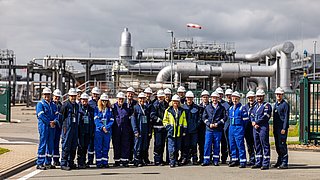
For the past three years, experts from both countries have been exchanging views on the development of natural gas storage infrastructure as part of the German-Israeli Energy Partnership. To further strengthen this cooperation, an Israeli delegation comprising representatives from the Ministry of Energy and Infrastructure, the Gas Authority, the Fuel Authority, the long-distance gas network operator and the Israeli technical standards body visited northern Germany in June 2026. Whilst there, the Israeli experts toured various natural gas storage facilities and associated infrastructure and exchanged views with specialists from German companies and technology providers, the Federal Ministry for Economic Affairs and Energy (BMWE), the Federal Network Agency, the Lower Saxony State Office for Mining, Energy and Geology, and other technical experts.
This bilateral exchange has made a significant contribution to the design of an Israeli model for the national natural gas storage infrastructure and the technical requirements it must meet. With the publication of the first calls for tenders for a financing and operational management concept for a planned natural gas storage facility with a capacity of two billion cubic metres of natural gas (bcm) by the Israeli Ministry of Energy and Infrastructure, the project is entering its next phase – offering German companies promising opportunities for participation.
For further reading, please see the press release from the Ministry of Energy and Infrastructure of the State of Israel.
Please get in touch with us
-
 © HoffotografenNikias Wagner
Teamlead MENA
-
 Hrvoje Brlecic Layer
Expert, Infrastructure & energy system