Energy Use Case: Data Exchange for the Energy Transition
Exchanging data securely, confidently and efficiently between countless stakehold
Goal: Developing and testing practical solutions for more efficient data exchange in the energy sector
Topics: Digitisation, Legal framework, Infrastructure, Innovation, Driving digitalisation and innovation
Runtime: 2023 to 2026 (autumn)
Our mission

An increasingly decentralised energy system can only be managed efficiently, flexibly and resiliently if data can be exchanged securely, in a standardised manner and across sectors. Yet data exchange is still not thriving: data is often stored in isolated systems and formats that are not compatible with one another. There is a lack of clear rules governing security, access rights and common interfaces.
That is why the ‘Energy’ use case examines, by way of example, the key challenges and opportunities presented by improved data exchange in the energy sector: What obstacles do companies face? What added value does better data utilisation bring? And what technical, regulatory and organisational prerequisites are needed to ensure that data-driven solutions can function and scale in practice?
Our approach
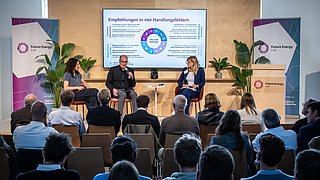
We combine the practical testing of new solutions in a test bed with an in-depth dialogue with the industry. The findings are collated, prioritised and fed back to policy-makers and the industry.
The focus is on three use cases that enable the integration of small, decentralised installations into the electricity system:
- Access to consumption and generation data from small-scale installations
- Consumption records for electric car charging
- Variable grid tariffs
Together with 21 project partners, we are putting these use cases into practice with the help of an energy data room. Experts from the digital and energy sectors are supporting the project through three working groups and an Energy Board (47 members), evaluating the results and providing specialist input and quality assurance.
A variety of participation formats enable stakeholders from the energy sector, politics, research and civil society to contribute their perspectives.
All experiences, findings and recommendations for action are compiled and published in a manner tailored to specific target groups, with a view to driving forward the further development of the data ecosystem in the energy sector.
Our milestones
2024: Laying the foundations and defining the first use cases
- February – March: Identification of the most urgent areas for action based on an industry survey on challenges relating to data exchange in the energy sector
- August: Start of implementation of the test bed for practical testing of the use cases
- September: Launch of the industry dialogue on the ‘Energy’ use case
- November: Launch of the supporting working groups and the Future Energy Dialog digital platform
Publication of topic-specific factsheets
2025: Testing and intensive industry dialogue
- February: Launch of the Energy Board meetings
- June: Selection and implementation of the Re4DE connector with the two identity variants SM-PKI (Smart Meter Public Key Infrastructure) and SSI (Self-Sovereign Identity). Re4DE stands for: Reference System for Secure Data Exchange in the Energy Sector.
- July: First industry meeting as a joint public event with the BMWE – theme: ‘Sharing data – for a sustainable energy system’
- August: First Re4DE hackathon (focus: connection to the data room and mapping of a new use case)
- November: Publication of the policy paper ‘A clear structure for greater momentum’ by BMDS
December: Test drive from Etteln to Berlin in an electric car to demonstrate the portability of domestic electricity contracts
2026: Implementation in practice and scaling
- February: Publication and adoption of the Re4DE connector by the neighbouring project energy-data-X. Easy reuse via open source enables good solutions to be rolled out widely and quickly.
- April: Second Re4DE hackathon (focus: operation of the connector)
- June: Second industry meeting as a joint public event with the BMDS motto ‘Generating value together with data – data spaces for the energy transition’
- June – September: Publication of guidelines, analyses, studies, accompanying technical documentation and final project reports