Polish-German pilot project: District heating across borders
A groundbreaking pilot for cross-border energy projects in Europe
"United Heat" as a blueprint for cross-border energy projects
The significant potential of cross-border energy projects remains largely untapped across Europe. Permitting and operations remains complex. Claire Gauthier, an expert on European cooperation at dena, uses a pilot project to illustrate concrete solutions.
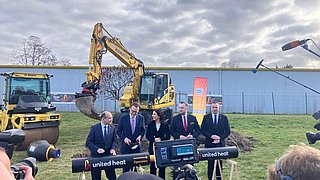
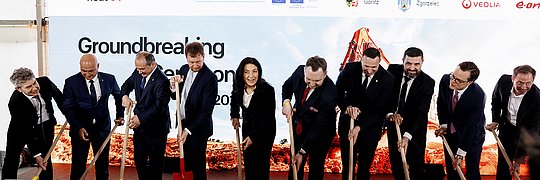
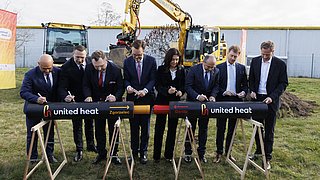
Germany’s Federal Minister for Economic Affairs and Energy Katherina Reiche, Polish Undersecretary of State Konrad Wojnarowski, Saxony’s Minister-President Michael Kretschmer, and 200 prominent guests attended the groundbreaking ceremony for a district heating pipeline at the end of March. The high-level turnout reflects the project's considerable symbolic significance. “United Heat” will connect the district heating networks of the cities of Görlitz and Zgorzelec across the Polish-German border, making heat supply more climate-friendly. Dena supports the United Heat project as part of the German-Polish Energy Platform, funded by the Federal Foreign Office.
Cross-border projects hold tremendous potential in Europe and are considered strategically important by the EU—yet they have rarely been realised in practice. Approvals and operations remain challenging, as they must comply with the rules of two national energy systems. As a result, these projects often break new regulatory ground. “United Heat” is therefore intended to serve as a blueprint for future endeavours.
Dena has been accompanying cross-border energy projects for around ten years and has been providing specific advisory support to the companies involved in "United Heat" for more than three years. We therefore know full well how much dedication, perseverance, and conviction those responsible have had to summon to overcome the obstacles on their path. For me personally, the ceremony was a particular moment. As a French national who grew up right on the border with Germany and as a committed European, this project demonstrates that Europe is continuing to grow closer together on energy matters—even if it isn’t always straightforward and takes time.
What “United Heat” is planning – und why it’s worth it
As part of the "United Heat" project, the companies Stadtwerke Görlitz and SEC Zgorzelec are jointly undertaking a fundamental transformation of heat supply in both cities. Gas and coal are being phased out; in future, heat will be generated from biomass, solar thermal systems, large-scale heat pumps, and waste heat.
What makes this particularly notable is that heat supply will in future be organised according to what is known as the merit order principle. Whichever facility is producing heat most cost-effectively at any given moment will be prioritised, regardless of which side of the border it is located on. As a result, generation costs will be lower than if both cities were to operate their networks separately. By switching to renewables, both cities will reduce their dependence on natural gas and improve air quality through the phase-out of coal.
As one of the very first projects of its kind, "United Heat" is being supported by a new EU funding programme for the cross-border expansion of renewable energy. In border regions, this means either pooling resources rather than duplicating infrastructure, or connecting demand on one side of the border with supply on the other.
Potential for 20 million people in border regions
The potential for cross-border projects is considerable: approximately 150 million people in the EU live in border regions. That is one-third of the EU’s total population. In Germany alone, the figure stands at around 20 million people.
The path to unlocking this potential is, however, anything but straightforward. Even domestic projects are demanding in their own right. Cross-border energy projects are more complex, more time-consuming, and more resource-intensive to develop and implement.
Two countries, two regulatory systems, two planning cultures, two languages. In concrete terms, this means: Two national legal frameworks must be analysed and, in the event of discrepancies, harmonised through regulatory coordination. Funding programs must be researched and combined. Building permits for cross-border power lines must be coordinated in parallel across two countries. And time and again, obstacles arise that nobody had anticipated.
Three approaches to unlocking the potential
Yet “United Heat” proves that it is possible. The following measures are key:
- Improving framework conditions: At the EU level, for example, harmonizing permitting procedures and targeted funding—such as the Cross-Border Renewable Energy Program—can help. At the national level, much can be achieved through exemptions, the adaptation of national funding programs, or the use of an experimental clause to assess the impact of a new legislation on border regions.
- Learning from experience: Cross-border energy projects share many challenges, such as funding issues, permitting problems, or a lack of local acceptance. What was painstakingly developed in Görlitz and Zgorzelec is transferable. No follow-up project needs to start from scratch.
- Connecting projects: “United Heat” should not remain an isolated case but become part of a growing European ecosystem. The exchange of knowledge between cities, project developers, and authorities is enormously beneficial — but requires active promotion both within Germany and across Europe.
With the groundbreaking, the project in Görlitz and Zgorzelec is slowly taking shape. "United Heat" stands as a model for other twin towns and border regions across Europe.