It's worth comparing costs before buying a car: Energy costs are often significantly lower for electric cars
Hannes Salomon, Team Leader Mobility, has developed a tool that breaks down the running costs of vehicles thus providing guidance when buying a car.

Buying and keeping your own car is an increasingly costly endeavour. According to a DAT survey from 2023, almost half of German drivers are worried that they will no longer be able to afford their own car in the future. Both purchase prices and the cost of fuel have risen drastically in recent years. Buyers are therefore well advised to consider not only the purchase price, but also the costs of running their vehicles. Electric cars are increasingly showing great potential cost advantages here.
Energy costs
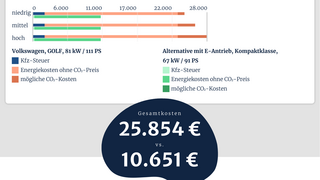
The cost of petrol and diesel has risen steadily in recent years. According to ADAC, 2023 was the second most expensive year for refuelling in history and recently (March 2024) the price of Super E10 was EUR 1.78 per litre. This trend will most likely continue in the coming years, partly due to rising CO2 prices. A look at the dena cost calculator reveals how energy costs could affect specific vehicle models:
The most popular car in Germany, the VW Golf (in this case we are assuming the following engine capacity: 81 kW/111 PS), is regarded as a reliable vehicle with moderate fuel consumption. Keeping the vehicle for 10 years and mileage of 15,000 kilometres per year generate total running costs of just under 26,000 euros. A comparable compact class electric vehicle costs just 11,000 euros to run. Energy costs make the biggest difference here, accounting for around 80 per cent.

Price of CO2
The price of CO2 is reflected in the price of fuel and is therefore part of the energy costs. However, if these are factored out, it becomes clear what a major influence the price of CO2 may have in the future. How exactly the price of CO2 will develop is uncertain. Various CO2 price scenarios are therefore mapped in the tool. If, according to the Federal Ministry for Economic Affairs and Climate Action's assumption, a moderate CO2 price path is assumed, additional costs of just under EUR 3,000 are incurred over the vehicle's service life, EUR 5,000 if the price of CO2 is high.
Differences in charging
With electric vehicles, not all charging is the same. The costs vary considerably depending on whether the vehicle is charged at home or at public charging stations. Charging at home is often around 30 per cent cheaper. At public charging stations, the kWh price is usually higher and additional fees are charged to users, but fast charging is sometimes possible.
Back to our example: If the vehicle is only charged at home, the charging costs after 10 years will be around EUR 10,000. If you always charge your vehicle at publicly accessible charging points instead, the cost is just under EUR 15,000. In contrast to the combustion engine, however, with fuel costs of EUR 21,000, electric vehicle owners come off much better in both scenarios.
Kfz-Steuer
In addition to energy costs, buyers of combustion engine vehicles also have to pay higher vehicle taxes. The decisive factors involved here are CO2 emissions, cubic capacity and the emissions standard. Electric vehicles, on the other hand, are still exempt from vehicle tax until 2030 and will then be assessed according to their weight. As a rule, these costs are significantly lower for electric vehicles than for comparable combustion engine vehicles.
In the previous example, a VW Golf would incur EUR 1,980 in vehicle tax over 10 years - but only EUR 256 for its electric counterpart (from 2031).
Choosing the right vehicle depends on a variety of factors, including individual driving habits and access to charging facilities. Consumers can now test for themselves how their own car will compare to an alternative drive system in the future using dena’s Cost calculator for cars.