International Knowledge Transfer: Moldova Shows Strong Potential for Agrivoltaics
A study visit to German pilot projects demonstrates how renewable power generation and agriculture can be successfully combined.
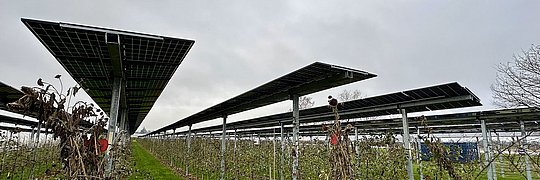
Above the vineyards of the Freiburg State Winery, long rows of solar panels are mounted on structures that slope down toward the valley. While grapes grow below, electricity is generated above – this is Agri-Photovoltaics (Agrivoltaics). The innovative technology enables the dual use of land for both agriculture and solar power production.
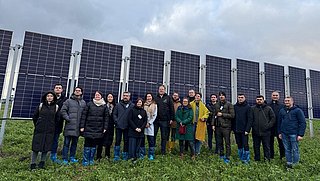
A delegation of 15 experts from three ministries, specialised agencies, companies, agricultural and energy associations, and universities travelled all the way from the Republic of Moldova to the far southwest of Germany to learn more about this technology. They listened with great interest to the presentation by research associate Hannes Engler, delivered with simultaneous interpretation. Engler explained that the Agrivoltaics installation on the Blankenhornsberg could theoretically supply electricity to 160 households, while also protecting the vines from excessive heat and sunburn. These are challenges that winegrowers are increasingly facing due to climate change – particularly in the Southeast European country of Moldova, with its important wine-growing regions.
Visit to Pilot Projects in Germany’s Leading Region for Agrivoltaics
In addition to visiting the Agrivoltaics installation in the vineyard, the Moldovan delegation explored several other pilot projects and leading research institutes in Baden-Württemberg from 24 – 28 November. The federal state has been testing different technological approaches within its “Agrivoltaics Model Region BW,” making it a pioneer in Germany. The German Energy Agency (dena) organised this delegation trip on behalf of the Federal Ministry for Economic Affairs and Energy (BMWE), with support from the Deutsche Gesellschaft für Internationale Zusammenarbeit (GIZ) on behalf of the Federal Ministry for Economic Cooperation and Development (BMZ). The aim of the trip was to provide Moldovan decision-makers from politics and agriculture with hands-on insights into the benefits of Agrivoltaics and to initiate a discussion on introducing this innovative approach in Moldova.
The trip is part of a project that dena has been implementing in Moldova on behalf of the BMWE since 2024. Moldova is already making strong progress in transforming its energy system to become more sustainable and secure - moving away from imported fossil fuels, which until 2022 consisted primarily of Russian natural gas, and toward decentralised and renewable energy generation. This ambitious reform process also supports Moldova’s goal of joining the European Union. Agrivoltaics, as an additional source of renewable electricity, can therefore play a key role in strengthening Moldova’s energy security while also contributing to the country’s integration into the European electricity market and its alignment with European standards.
Moldova’s Fruit Production and Sunny Climate Create Excellent Conditions for Agrivoltaics
Moldova has significant potential for Agrivoltaics. Around 75 percent of the country’s land is used for agriculture, making it a traditionally important sector of the Moldovan economy. Wine, fruit, and grain together account for nearly half of the country’s exports. At the same time, Moldova is already experiencing the effects of climate change, including longer heatwaves, heavy rainfall, and increasing irrigation needs.
Agrivoltaics offers solutions to these challenges. Elevated solar panels provide shade, protecting crops from excessive sunlight and heat, while helping to reduce water consumption. They also generate renewable electricity directly on the fields and can provide farmers with additional income streams. In this way, Agrivoltaics can help Moldova expand its use of renewable energy and reduce its strong dependence on fossil fuels such as natural gas.
In-Depth Insights into Research and Practice
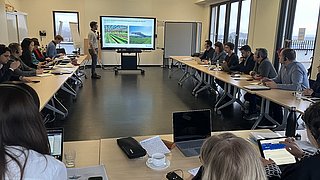
During the trip, scientists from Fraunhofer ISE, who play a leading role in Agrivoltaics research and implementation in Germany, provided the participants with comprehensive insights into current research – covering plant physiology, system design, irrigation concepts, and economic considerations. To make these insights more tangible, the delegation visited several projects showcasing different technological approaches. In addition to the Agrivoltaics installation at the State Winery, they visited farms and research facilities cultivating apples, cherries, plums, and berries in Heuchlingen and Oberkirch. This included a renewable energy cooperative with a 24-hectare installation featuring 67 rows of vertically mounted bifacial PV modules, between which organic cereals will be grown in the future. Project managers shared their experiences, challenges, and benefits in short presentations.
It became clear that sustainable yields, crop protection, efficient water use, and energy production can be effectively combined in practice. The visits were complemented by discussions with local companies, who presented business models, financing options, and practical implementation of Agrivoltaics.
In August 2025, the Republic of Moldova achieved a historic milestone by covering its electricity demand entirely from local renewable generation for a few minutes – a remarkable achievement after decades of dependence on imported fossil fuels. During the German-Romanian-Moldovan Business Conference in Stuttgart, which the delegation attended at the end of the trip, Moldova’s Minister of Energy, Dorin Junghietu, highlighted this success and emphasised the importance of Agrivoltaics for the country’s future energy supply, positioning it as a driver of innovation, growth, and sustainable energy solutions.