Green Skills for Vietnam’s Energy Transition
Education, Training and Cooperation in Focus at the 7th Hanoi Climate Talk
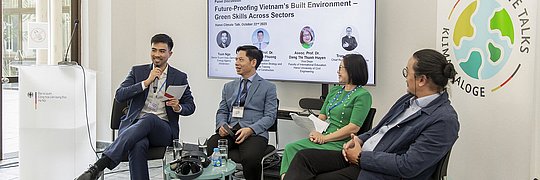
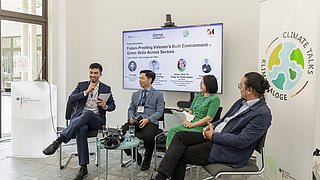
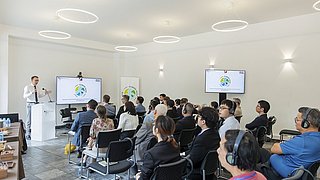
How can education and training accelerate the transformation toward a climate-neutral economy? This question was at the centre of the 7th Hanoi Climate Talk, held on October 22 in Hanoi. Under the title “Scaling Green Skills for the Energy Transition in Vietnam: A Shared Responsibility in Climate Diplomacy,” around 50 experts from Vietnamese ministries, universities, construction and energy companies, as well as German and international organizations, discussed how education and vocational training can lay the foundation for sustainable development.

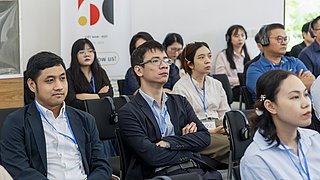
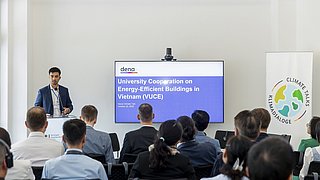
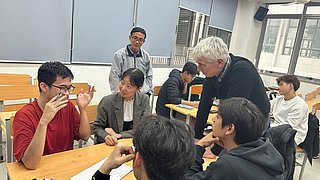
Climate Talks: Global Dialogue on Climate and Energy Issues
For the first time, the German Energy Agency (dena) hosted a Climate Talk — together with the Embassy of the Federal Republic of Germany in Hanoi. The Climate Talks are a global series of events initiated by the German Federal Government to promote international exchange on climate and energy topics. Organized by German embassies in partner countries, they bring together decision-makers to share experiences and develop joint pathways for implementing the Paris Agreement.
The theme of the 7th Hanoi Climate Talk was Green Capacity Building — in other words, developing the skills and competencies essential for the energy transition. The discussion focused on how qualified professionals can drive sustainable construction, renewable energy, and energy efficiency in Vietnam’s growing economy.
VUCE Project: Integrating Sustainable Construction into Education
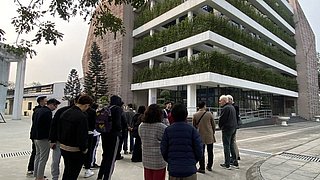
Among other things, dena presented the project “Vietnam University Cooperation on Energy-Efficient Buildings (VUCE).” This project was implemented jointly with the Hanoi University of Civil Engineering (HUCE) — one of the country’s leading universities — and funded by the International Climate Initiative (IKI) on behalf of the Federal Foreign Office (FFO).
The project clearly demonstrates how energy efficiency and sustainable construction can be more strongly integrated into university education and vocational training in Vietnam. By combining theoretical knowledge with practical application, VUCE supports the training of a new generation of professionals capable of implementing energy-efficient solutions in Vietnam’s construction sector.
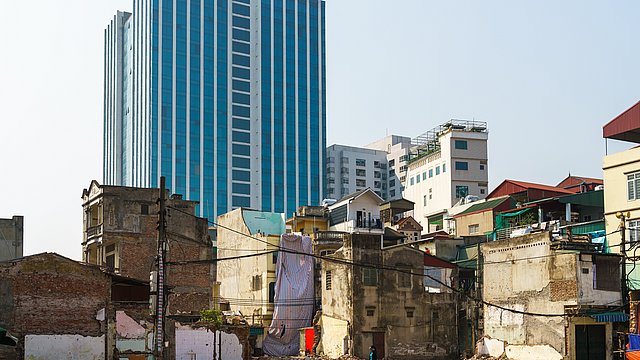
Beyond the project presentation, participants discussed how green skills can be systematically promoted in the construction and energy sectors, and how international partnerships can contribute. Many participants particularly emphasized the role of the private sector: design offices, construction companies, and technology providers are crucial for translating climate goals into concrete projects — and they need qualified professionals to do so.
The discussion in Hanoi made it clear: education and training are not side issues — they are the key to successfully shaping the transition to a climate-neutral economy.