Financing climate neutrality International exchange at dena
Instruments and strategies to finance the transition
How can countries mobilise the investment volumes needed to achieve climate neutrality? This question was at the center of a two-hour dialogue hosted by dena. The exchange brought together an international delegation on invitation of the Federal Foreign Office and experts from dena. The event offered an in-depth look at Germany’s investment needs and its financing landscape — across public, private and hybrid instruments.
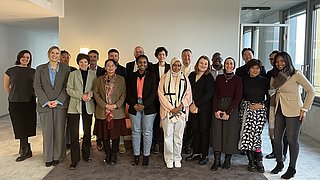
The Goethe-Institute’s Visitors Programme organised this exchange on behalf of the German Federal Foreign Office as part of an information and networking tour. The delegation comprised 15 representatives from Somalia, South Africa, Turkey, Seychelles, Rwanda, the Republic of Korea, Mongolia, Kazakhstan, Indonesia, Fiji, Egypt, Colombia, China, Brazil and Argentina. Participants came from ministries of environment and finance, central banks, universities, business associations, chambers of commerce, think tanks, NGOs, and major media outlets. Their shared aim: to gain nuanced insights into global and German approaches to financing the transition to climate neutrality, while strengthening international networks among policy and financial decision-makers.
Exploring climate finance: Global perspectives on innovation, risk, and investment
The participants brought a wide range of interests to the programme. Key topics included just transition finance and Germany’s role in the Just Energy Transition Partnership, innovative financing instruments such as blended finance, public–private partnerships, debt-for-climate swaps and guarantee structures. Additionally, discussions covered carbon markets, emissions trading systems and the legal frameworks for climate action.
Some participants were keen to understand
how public funds can catalyse private investment,
how climate factors can be integrated into fiscal frameworks and debt management, and
how financial risks linked to climate transition policies can be assessed.
Further areas of interest included climate insurance, resilience and disaster-risk financing — such as parametric insurance solutions and regional risk pools — alongside insights into the Green Climate Fund, the Adaptation Fund, the International Climate Initiative (IKI) and financing mechanisms relevant for Small Island Developing States.
dena’s expertise on financing Germany’s path to climate neutrality: From industry transformation to serial renovation
The session at dena began with a keynote by Nora Kögel, Energy and Climate Policy Expert, on Germany’s pathway to financing its transformation toward climate neutrality. It continued with two project spotlights: Helena Mölter, expert in Energy Efficiency and Industrial Transformation, presented on required and existing instruments for the transition of industry, followed by Paula Baptista, senior sxpert in Serial Renovation, who highlighted serial retrofits as a key technology for the climate transition. These inputs set the stage for a lively discussion with the international delegation.
Participants engaged in a wide range of topics reflecting global challenges in linking climate policy with investment decisions. Central discussions focused on:
the EU taxonomy,
European Standards and Guidelines (ESG) standards, and
the prevention of greenwashing;
energy efficiency and the regulatory frameworks that support it; and
the role of Carbon Capture and Storage (CCS) in Germany’s long-term climate strategy.
Paula Baptista’s input sparked an engaging discussion on the Energiesprong model of serial retrofitting, with participants expressing interest in how the interplay of key policies and technologies could support investment momentum in their own markets. Attention was also given to hydrogen production, use, and financing, alongside the development of enabling infrastructure, as well as public and public–private cooperation models.
There was also strong interest in how Germany structures responsibilities across federal, state, and municipal levels. Participants discussed the city of Konstanz as a concrete example of how local authorities can advance climate-neutral development by leveraging a mix of different financing options.
Strengthening international collaboration
After the closing remarks, participants and dena employees continued their exchange, deepening connections and exploring opportunities for future cooperation.
The event demonstrated once more that financing the transition to climate neutrality is a shared global challenge. dena is committed to contributing expertise, facilitating dialogue, and collaborating with international partners on pathways toward a climate-neutral future.