German-Polish Forum on Energy Transition 2024: Important milestone for the future of European energy policy
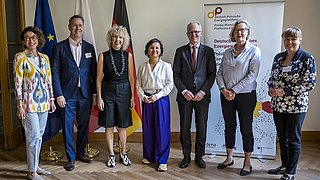
Germany and Poland are continuing their bilateral dialogue to jointly tackle the challenges of the energy transition. At the 2nd German-Polish Forum on Energy Transition in Berlin, representatives from politics, business and civil society shared their perspectives to develop concrete steps for a sustainable energy future. The Forum paves the way for closer German-Polish cooperation and gives new impetus to the energy transition in Europe.
Berlin, 17 May 2024: Germany and Poland reaffirmed their commitment to cooperating on climate and energy policy. Today, more than 120 participants from ministries, companies, associations, research institutions, and NGOs from both countries met at the Federal Foreign Office in Berlin to discuss implementation options and ways to increase energy policy cooperation between the two countries, as well as at the European level. The forum was organised by the German Energy Agency (dena) and the Polish National Energy Saving Agency (KAPE). It was organised on behalf of the German Federal Foreign Office in partnership with the German-Polish Chamber of Commerce (AHK Poland) and the Embassy of the Republic of Poland. The inaugural event took place in Warsaw in April last year and forms a key part of the German-Polish Energy Platform, which has been operational since late 2021.
The aim of this year's forum was to improve the mutual understanding of energy policy priorities and pool the efforts of the two countries. Against the backdrop of the European elections and the upcoming Polish EU Council Presidency at the beginning of 2025, the event aimed to provide new impetus at the EU level. The event focused on issues relating to the implementation of a socially responsible transition to cleaner heating and the decarbonisation of industry as a driver of growth. Germany and Poland face similar challenges in their respective energy transitions. The panellists discussed the status of the heating transition in both countries, as well as the impact of different national funding instruments. They also discussed the decarbonisation of industry, focusing on the potential for creating new jobs and enhancing energy security through new technologies and business models.
Jennifer Morgan, German State Secretary and Special Envoy for International Climate Policy at the Federal Foreign Office, said, “We can only solve the climate crisis and advance the green transformation together. If we Europeans join forces and invest in decarbonising our industry, we will ensure that Europe remains competitive and helps to shape the green markets of the future.” In Germany, as in Poland, we are committed to a fair energy transition that combines necessary structural change with opportunities, leaving no one behind. This is an energy transition that creates jobs, secures quality of life, and fosters prosperity.”
Urszula Zielińska, Polish State Secretary at the Ministry of Climate and Environment, emphasised the challenges and opportunities of an ambitious energy transition: “In Poland, the path to transformation has been evident since the 15 October 2023 elections at the latest, aligning with the broader direction of the European Union. The targets set out in the EU Climate Law — reducing CO2 emissions by 55% by 2030 and achieving climate neutrality by 2050 — are also our goals. Essentially, it is about improving energy efficiency in the economy and in our households. It's about an energy mix based on domestic onshore and offshore wind resources. It's about solar energy, biogas and biomethane, nuclear power and green hydrogen, for which we are preparing a new legal framework this year. In addition, we are converting district heating to low-temperature grids, large heat pumps and heat storage systems powered by renewable energies and renewable gas, as well as implementing modern digital management systems.”
Kristina Haverkamp, the Managing Director of the German Energy Agency (dena), emphasises the importance of close cooperation between Germany and Poland for the energy transition. She says, “Through constructive exchanges at forums like this one, we can develop solutions that will advance not only our own countries, but also Europe as a whole. The German-Polish Energy Platform is already helping the cities of Görlitz and Zgorzelec to connect their district heating networks, with the aim of supplying the entire European city with climate-neutral district heating.”
Karolina Loth-Babut, Managing Director of the Polish National Agency for Energy Saving (KAPE), highlights the shared challenges that Poland and Germany face in the context of ever-increasing climate change: 'The shared climate challenges, including the energy transition, present a significant opportunity to foster international collaboration and transform these challenges into opportunities. This forum is a valuable opportunity to bring together the various stakeholders in the energy transition process and achieve synergistic action for a better future”.
An expanded supporting programme and new partnerships
For the first time, the German-Polish Forum on Energy Transition was part of a supporting programme. In addition to a festive evening reception, two side events were organised, and new cooperation partners were acquired. The evening before the forum, representatives of German and Polish think tanks and NGOs met to discuss energy and climate policy cooperation at a civil society level. This event was held in the German Bundestag in collaboration with Germanwatch. Later in the evening, participants were invited to a reception at the Polish Embassy.
-
 © HoffotografenSebastian Boie
Senior Expert, Communications T: +49 30 66 777 - 168 sebastian.boie(at)dena.de